


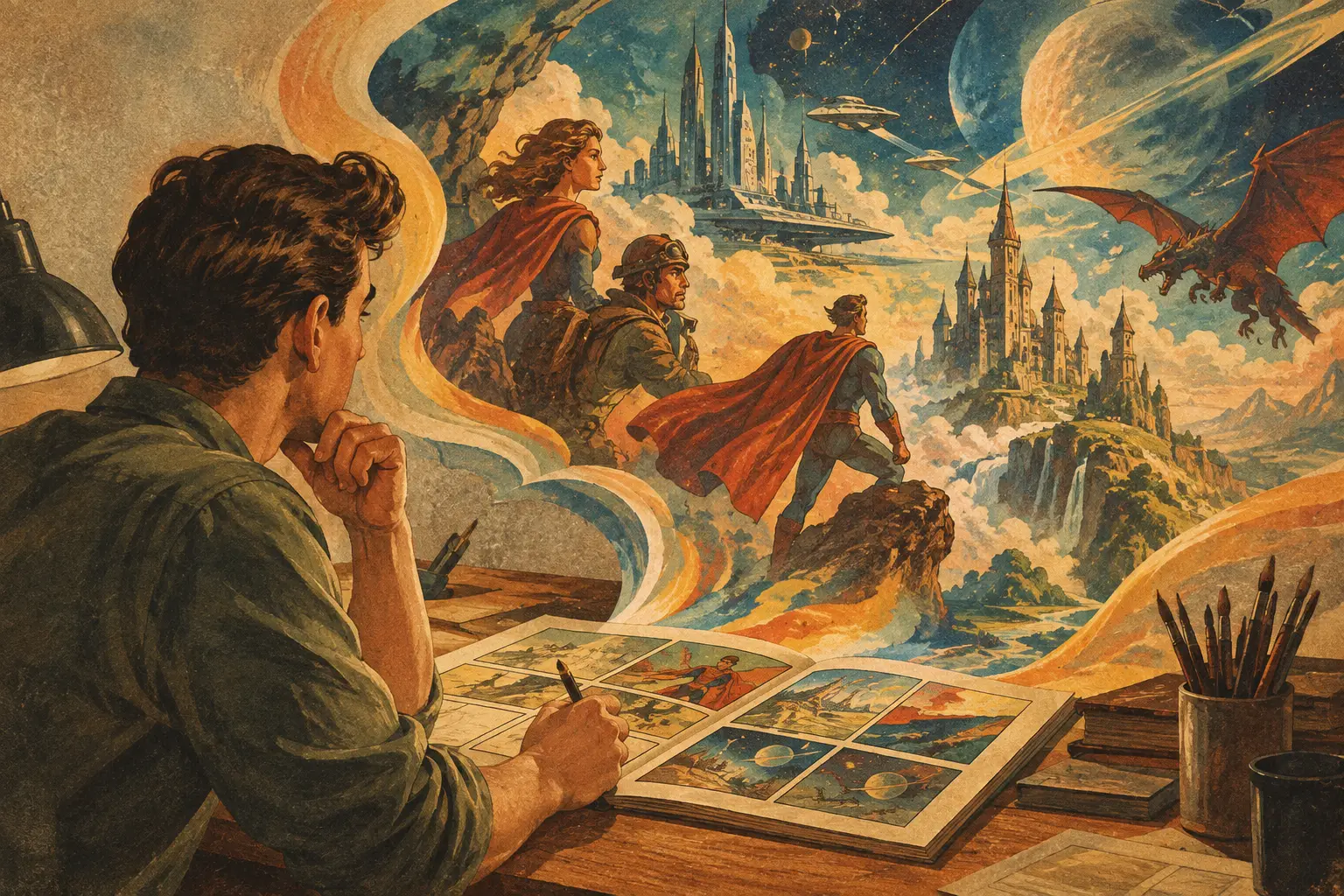
Kickstarter Comics Are Where New Universes Begin

A new comic universe does not begin when it reaches a crowded store shelf. It begins when the first reader decides a strange signal is worth answering. Kickstarter comics put fans at that moment of first contact: before the canon hardens, before the characters become familiar, before the battle for a universe has been decided.
For readers who want more than another recycled origin story, that early access matters. Independent creators can build worlds with sharper edges, stranger species, riskier ideas, and conflicts that major franchises may never touch. The reward is not only a book in the mail. It is a place in the transmission history of a story that might become enormous.
Why Kickstarter Comics Feel Different
Traditional comic publishing often asks creators to prove that an idea already fits a known market. A campaign asks a more dangerous and exciting question: can this idea create its own gravity?
That changes the relationship between reader and creator. Backers are not anonymous consumers arriving after every decision has been made. They are the first audience to see the concept art, absorb the campaign language, choose editions, and give a new mythology enough fuel to enter orbit. When a campaign funds, it is a public declaration that a story has found its people.
This does not mean every crowdfunded comic is automatically better than a book from a major publisher. Big publishers bring editorial infrastructure, distribution, and decades of craft. But Kickstarter creates room for stories that do not need to sand down their identity to earn permission. A comic about sentient machines afraid of their own emotions, alien biology that resists human categories, or warfare waged inside consciousness can stay unsettling. It can stay specific.
That specificity is the real collectible.
Kickstarter Comics Give Fans a Stake in the Signal
There is a difference between buying a comic and backing a launch. Buying says, “I want to read this.” Backing says, “I want this to exist.”
For fandom-minded readers, that distinction carries weight. A successful campaign can finance an artist’s pages, lettering, colors, printing, packaging, and the long, invisible work of delivering a physical object with care. It can also give a creator the confidence to plan beyond a single issue. The first chapter becomes evidence that the audience is ready for the next transmission.
The best campaigns recognize that support should feel meaningful without turning the book into a pile of distractions. Variant covers, signed editions, limited extras, and campaign-exclusive artwork can be powerful because they mark a reader’s arrival at the beginning. They work best when the core comic remains the center of gravity.
A rare cover is not a substitute for story. It is a physical record of belief in the story.
That is why readers should look past the loudest reward graphics. Ask what the comic promises on the page. Is there a character conflict beneath the visual spectacle? Does the setting have rules, pressure, and consequences? Does the campaign suggest that its creators know where the story is headed, even if they wisely keep some coordinates classified?
What Makes a Campaign Worth Backing
A campaign page can be cinematic and still be unclear. Great art matters, but clarity is its own form of respect. Before committing, readers should be able to understand the premise, the creative team, the format of the book, the delivery window, and what makes this issue distinct.
The strongest Kickstarter comics usually offer a clean entry point. They do not demand an encyclopedia of prior knowledge. Instead, they establish a door into a larger universe: a fracture in a government, a machine that should not feel grief, an explorer who finds something looking back from deep space. Issue #1 should make a promise and create enough tension that refusing Issue #2 feels impossible.
Creative transparency matters just as much. Comics are collaborative objects. Writing, pencils, inks, colors, lettering, design, editing, and fulfillment all affect the final experience. When a campaign identifies the people doing that work, it signals that the project is built by a real team rather than an unfinished idea projected into the void.
Readers should also respect the difference between ambition and readiness. An independent campaign may face production delays, particularly when it involves elaborate art, specialty printing, or a first-time fulfillment operation. That is not automatically a warning sign. Silence is the warning sign. Creators who communicate clearly when the schedule shifts are protecting the trust that made the project possible.
The Variant Cover Question
Variant covers can ignite the collector instinct for good reason. A cover is the first visual encounter with a universe. It can reveal the menace of an antagonist, turn a hero into an icon, or preserve a single impossible image from a pivotal campaign.
Yet collectors should choose with intention. An exclusive variant is most satisfying when it connects to the series rather than simply multiplying artificial scarcity. Maybe it captures a major character in a different light. Maybe it celebrates the launch window. Maybe its design reflects the story’s central question: who controls the body, the machine, the planet, or the mind?
If the budget allows only one edition, choose the version you will be glad to hold and reread. Collectibility has resale language around it, but the deeper value of a comic is emotional. Years later, the meaningful issue is often not the rarest one. It is the one that introduced you to a world before anyone else knew its name.
A New Kind of Science Fiction Needs Direct Support
Science fiction is at its most alive when it treats the future as an argument, not a wallpaper. Artificial intelligence changes who gets to claim personhood. Climate collapse changes the cost of leaving Earth. Contact with alien life changes the stories humanity tells about itself. These ideas deserve comics willing to make their characters suffer the consequences.
Crowdfunding is especially suited to this territory because it lets audiences gather around a premise before gatekeepers decide whether it is familiar enough to sell. The Controllōrs™ Universe enters that space with a 2050 cosmic conflict where the prize is control itself: over flesh, consciousness, technology, and the future of life across the known universe.
That kind of story needs readers who welcome uncertainty. Not every answer should arrive in the opening pages. Mystery is not confusion when the world feels deliberate. A hidden agenda, a compromised machine, or an alien force beyond human language can create the pressure that turns lore into obsession.
Back the Story, Not Just the Hype
Campaign energy can move fast. Countdown clocks, stretch goals, and limited editions are designed to create momentum, and there is nothing wrong with that. A launch is an event. But the campaigns that endure are built on a lasting exchange: creators offer a story with conviction, and readers give it time, attention, and trust.
If a premise catches your imagination, read the campaign carefully. Look for the human nerve inside the cosmic scale. Find the question that will keep pulling at you after the last page: Can a programmed being choose? What does survival demand? Who benefits when control is called safety?
Then back the signal that stays with you. The next universe may not arrive through a corporate portal or a familiar logo. It may begin with a first issue, a dangerous idea, and a reader willing to say: send the story forward.
Comments