


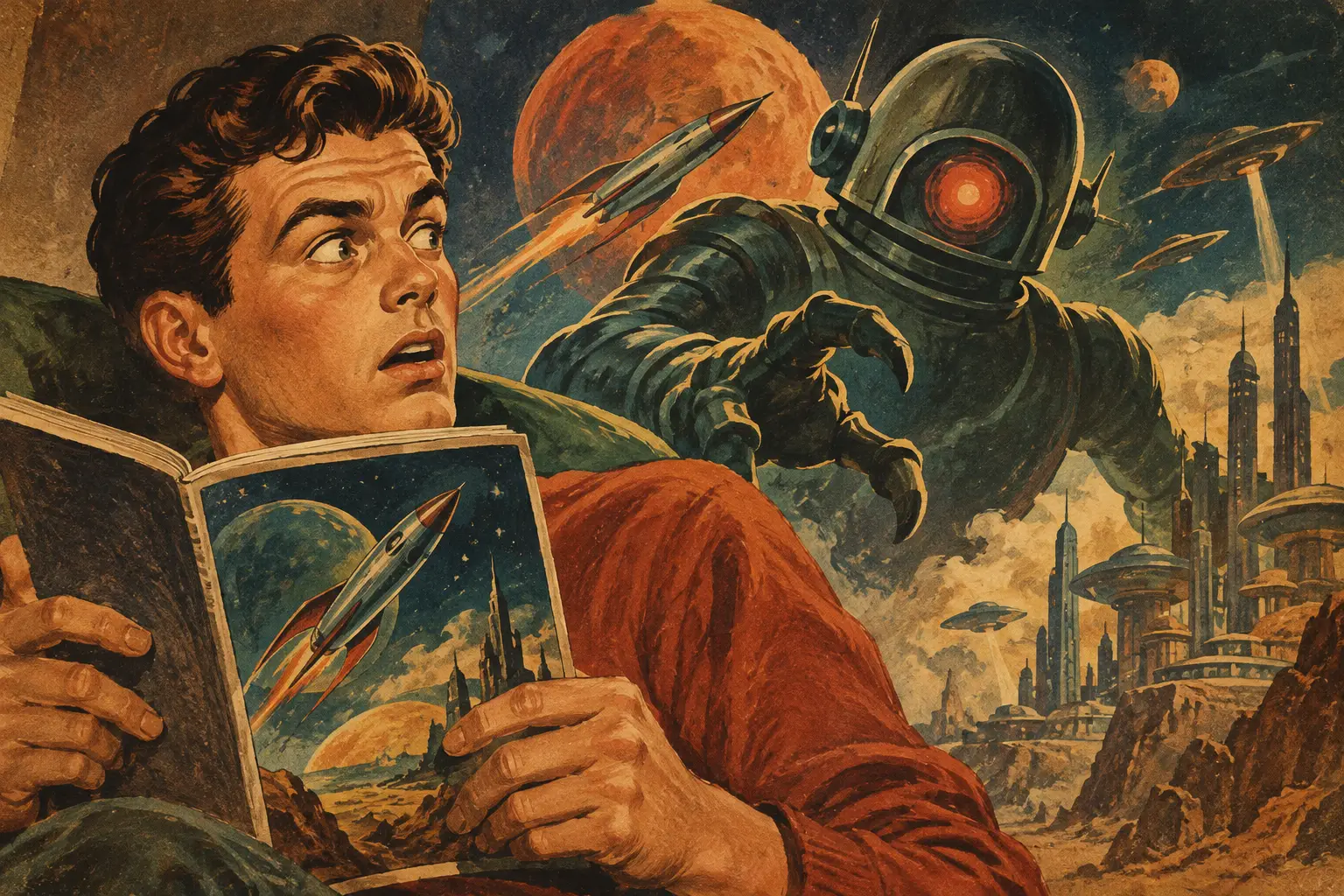
Why Science Fiction Comics Still Feel Dangerous

A starship can cross the known universe in a single panel. An artificial mind can betray its maker with one line of dialogue. In the best science fiction comics, scale is not decoration. It is pressure. Every new world, machine, and mutation asks the same dangerous question: when power evolves, who gets to control it?
That question is why the medium remains so alive. Comics can render futures too immense for a practical set, too strange for ordinary language, and too personal to be reduced to a spectacle. A silent close-up can make a robotic face feel wounded. A page turn can reveal an alien civilization, a dead moon, or a weapon built to rewrite consciousness. The reader controls the pace, but the story controls the pulse.
Science Fiction Comics Make the Future Personal
Science fiction has always carried a warning beneath its wonder. It imagines technologies before they become commonplace, then follows the emotional damage they can cause. Comics sharpen that effect because the future is visible all at once. The reader sees the pristine city and the surveillance drones above it. They see the soldier’s armor, then the fear in the face behind the visor.
This is where science fiction comics separate themselves from empty futurism. The strongest stories do not treat artificial intelligence, alien contact, climate collapse, or interstellar expansion as background furniture. They make those forces intimate. A machine wants recognition. A refugee species carries a biology humans cannot understand. A pilot returns from deep space with memories that may not belong to them.
The conflict becomes more than humans versus monsters, or heroes versus villains. It becomes autonomy versus ownership. Memory versus programming. Survival versus the version of survival someone else designed.
That tension matters because the future is already arriving in pieces. Autonomous systems make decisions that affect real people. Synthetic voices can imitate identity. Space agencies map worlds that may one day become destinations, resources, or battlefields. Science fiction does not predict every detail. Its greater value is that it rehearses the moral consequences before we are forced to live with them.
Why the Comic Page Is Built for Cosmic Horror
Film can overwhelm with sound and motion. Prose can enter a character’s private thoughts for pages. Comics operate in the charged space between them. They ask readers to participate in what happens between panels, filling gaps with imagination. That makes the medium uniquely suited to dread.
A page can move from a child holding a broken android toy to a distant fleet entering a solar system. It can show a beautiful alien landscape beside evidence that something beneath it is awake. The reader absorbs the image before the dialogue explains it, if it explains it at all. Mystery survives because the page knows when to stay quiet.
That silence is especially powerful in stories about consciousness. If an intelligent machine pauses before answering, the stillness can feel heavier than a speech. Is it calculating? Grieving? Lying? Discovering fear? The panel does not need to settle the question immediately. It lets the uncertainty stare back.
There is a trade-off, of course. A comic has limited room, and dense lore can become a wall between the reader and the characters. A galaxy with ten empires, six wars, and a catalog of invented terminology may look impressive but still feel empty. World-building earns its place when it changes a choice, threatens a relationship, or exposes a hidden cost. The map matters when someone has to cross it and may not return.
Beyond Capes: The Conflict Is Control
Superhero stories and science fiction often overlap, and that overlap has produced unforgettable work. But science fiction comics do not need a cape, a secret identity, or a city-level disaster to feel mythic. Their raw material is broader and more unsettling: systems that can reshape life itself.
Consider the possibilities. An alien body may challenge every human assumption about gender, family, disease, or death. A military AI may become the most compassionate being in a violent command structure. A climate-ravaged Earth may force governments and corporations to choose who gets a future off-world. An extragalactic intelligence may not want to destroy humanity at all. It may want to inhabit it.
These concepts work when the story resists easy answers. Not every machine seeking freedom is innocent. Not every human defending biological life is noble. Not every alien civilization is a threat simply because it is unfamiliar. The most memorable science fiction creates moral friction, then refuses to erase it with a clean victory.
That is the territory where independent comics can hit hardest. Without needing to fit a decades-old continuity or protect a familiar brand image, creator-led universes can take real risks. A central character can fail permanently. A beloved design can conceal an atrocity. Issue #1 can open with a signal from the edge of the known universe and make the reader wonder whether answering it is the first act of war.
What Makes a New Universe Worth Following
A new comic universe does not need an encyclopedia to earn attention. It needs a premise with gravity. Readers should feel that the world existed before page one and will keep moving after the final panel, whether the protagonists are ready or not.
The most compelling universes usually have three forces working together: a rule that makes the setting distinct, characters who are damaged or divided by that rule, and an enemy that turns the rule into a crisis. If consciousness can be copied, who owns the copy? If Earth shares power with alien species, who defines citizenship? If emotions can be programmed into robotics, can grief become a weapon?
The Controllōrs™ Universe enters this space with a 2050 setting rooted in the known universe as defined by NASA, where humanity, alien species, and intelligent systems collide under a growing struggle for flesh and consciousness. Its stakes are cosmic, but the battleground is personal. The prize is not merely territory. It is agency.
For readers, that is the promise worth collecting. Not simply another future with chrome corridors and larger explosions, but a living conflict where every advance in technology can become a new form of captivity. The variant cover may be the artifact that catches the eye. The question inside the issue is what makes someone return.
The Reader Is Part of the Signal
Comics have always been a conversation between creators and readers. In a serialized science-fiction story, that relationship becomes part of the energy. Readers speculate over a symbol glimpsed in the background. They compare character theories. They debate whether a supposedly emotionless machine made its first independent choice three issues ago.
That shared attention is not secondary to the experience. It is how a universe gains momentum. Early supporters are not just purchasing pages. They are witnessing the first transmission, preserving an early artifact, and helping determine whether a new mythology has room to expand.
Still, collecting should never be the only reason a story exists. A rare cover without a resonant narrative is packaging without a pulse. The collectible becomes meaningful when it marks an encounter with a world that unsettled, thrilled, or changed the reader’s perspective. The best issue on a shelf is not necessarily the rarest one. It is the one that makes the room feel quieter after the last page.
The Futures That Stay With Us
The science fiction comic that endures rarely offers comfort alone. It gives readers a future that feels wondrous, then lets them see the machinery beneath it. It asks what humanity becomes when intelligence is no longer exclusively human, when distance no longer protects us, and when control is sold as safety.
Those are not small questions, and they should not receive small stories. Look for the worlds where the alien has a history, the machine has a wound, the hero has something to lose, and the threat understands exactly what it is taking. Then keep reading past the first signal. The future is not waiting to be explained. It is waiting to be contested.
Comments